Jaya-Optimized Support Vector Regression for Software Effort Estimation using Mutual Information Feature Selection
DOI :
https://doi.org/10.67868/nijor/0302.05Mots-clés :
Software Effort Estimation, Support Vector Regression, Jaya Algorithm, Mutual Information, Feature SelectionRésumé
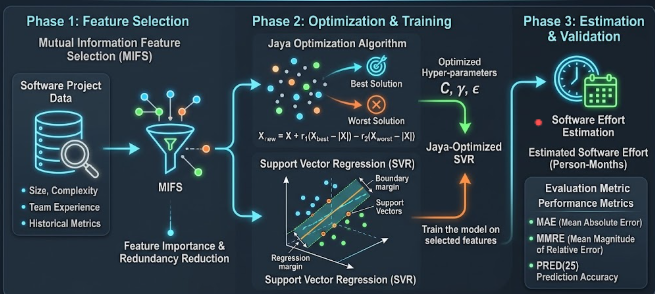
Software effort estimation remains one of the most challenging tasks in project management, prompting researchers to explore advanced machine learning techniques for improving prediction accuracy. While many existing studies focus either on feature selection or model optimization, only a limited number have investigated the combined impact of these two approaches. To address this gap, this study proposes SVR-JAYA FS, a hybrid model that integrates Mutual Information-based feature selection with Jaya algorithm-based hyperparameter optimization for Support Vector Regression (SVR) in software effort estimation. The model was evaluated on twelve benchmark datasets from the PROMISE and GITHUB repositories using ten performance metrics and compared with a standard SVR model, an optimized SVR-JAYA FS model, SSA-BPNN, and six classical regression techniques. Results show that SVR-JAYA FS consistently outperforms the standard SVR across all datasets, achieving R² improvements of up to 99.45%, while also reducing execution time by as much as 55%. Compared with SSA-BPNN and classical regression methods, the proposed model demonstrated superior or competitive performance on most datasets. The findings indicate that integrating feature selection and hyperparameter optimization significantly improves both prediction accuracy and computational efficiency, particularly for datasets with a larger number of features, making SVR-JAYA FS a robust and practical approach for software effort estimation.
Références