A Formal Ontology Evaluation Methodology for Education-Domain Knowledge Graphs
DOI:
https://doi.org/10.67868/nijor/0303.026Keywords:
Ontology Evaluation, Knowledge Graphs, Education Domain, Ontology Quality Metrics, OQuaRE, Bloom's Taxonomy, Semantic Web, Formal MethodsAbstract
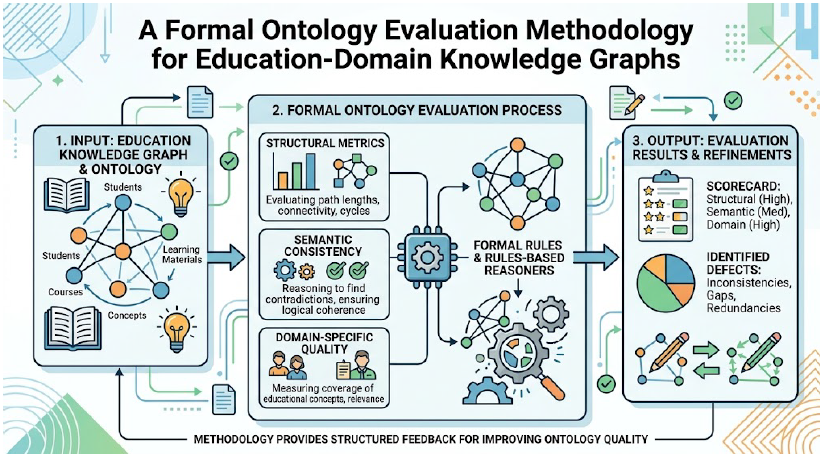
Knowledge graphs built on domain ontologies increasingly underpin adaptive learning platforms, learning-analytics dashboards, and personalized recommendation systems in education. The quality of the underlying ontology directly determines the reliability of the resulting knowledge graph and, consequently, the pedagogical decisions derived from it. Yet most existing ontology-evaluation frameworks were designed for general-purpose, biomedical, or enterprise ontologies and do not explicitly account for pedagogical constructs such as alignment with Bloom's/Anderson's taxonomy, learning-objective traceability, or curriculum granularity. This paper proposes a formal, multi-layer methodology for evaluating education-domain ontologies and the knowledge graphs derived from them. The methodology combines structural, logical, functional, pedagogical-fitness, and usability layers into a single weighted quality score, with weights elicited through stakeholder-driven requirements analysis. We review the state of the art in general ontology evaluation and in education-domain ontology development, formalize the proposed scoring model, and illustrate its application through a case study on a syllabus and learning-objective knowledge graph. The methodology gives ontology engineers and instructional designers a reproducible, criterion-based instrument for assessing and improving education-domain ontologies before deployment in production learning systems.
References