Gaussian Process-Homotopy Analysis Method for Tuberculosis Transmission With Stiff Dynamics and Time-Varying Contact Rate
DOI:
https://doi.org/10.67868/zaxbyn49Keywords:
Tuberculosis, GP HAM, Stiff ODEs, Uncertainty quantification, Time varying parametersAbstract
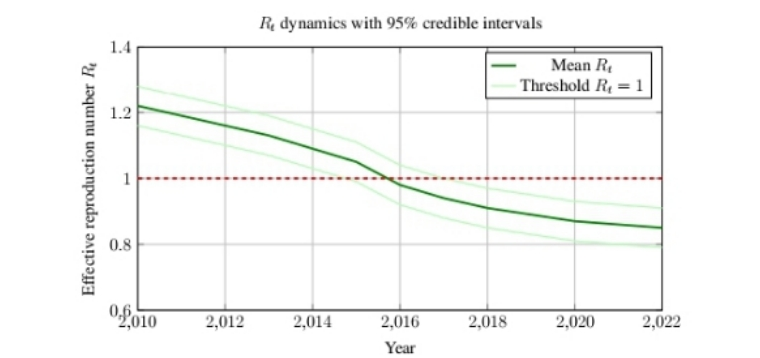
Tuberculosis (TB) models are often stiff because they combine fast bacterial dynamics with slow disease progression, and the contact rate often changes unpredictably over time. To handle both challenges, we developed GP‑HAM, a hybrid method that joins the stable, semi‑analytical Homotopy Analysis Method with Gaussian Process regression to infer the time‑varying contact rate and quantify its uncertainty. Tests on synthetic data and real‑world Nigerian TB records show that GP‑HAM cuts prediction errors by 46–58% compared to standard explicit Runge‑Kutta, gives 95% credible intervals that cover the true values 93.8% of the time, and produces no numerical oscillations. Sensitivity analysis reveals that the contact rate and the progression rate from latent to active TB are the most influential parameters. Overall, GP‑HAM is a ready‑to‑use tool for modelling TB in settings where data are scarce, models are stiff, and uncertainty matters.
References