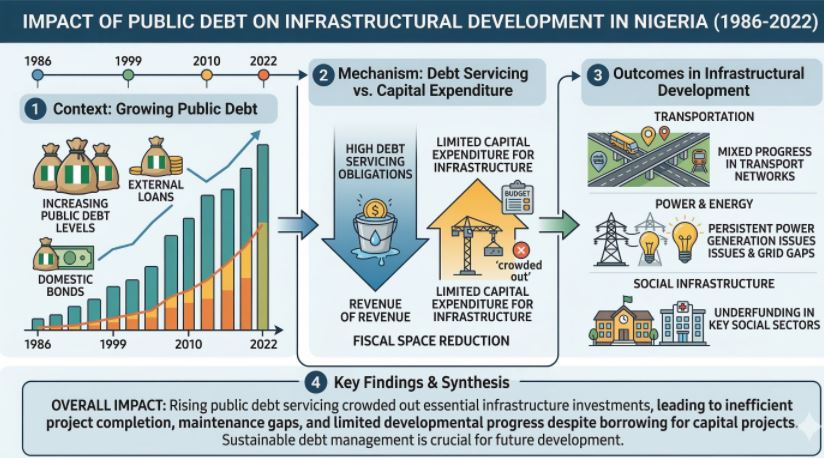
Impact of Public Debt on Infrastructural Development in Nigeria (1986–2022)
DOI:
https://doi.org/10.67868/yc9a9295Keywords:
Public Debt, Infrastructure Development, Domestic Debt, External Debt, ARDL, NigeriaAbstract
Nigeria’s persistent infrastructure deficit has remained a major constraint to sustainable development despite rising levels of public borrowing. This study investigates the impact of public debt on infrastructural development in Nigeria from 1986 to 2022. Annual time-series data were analysed using the Autoregressive Distributed Lag (ARDL) bounds-testing approach to examine both the short- and long-run relationships among the variables. The findings reveal that domestic debt and human-capital development exert a positive and significant impact on infrastructural development in the long run, whereas external debt negatively affects infrastructure growth. The estimated error-correction term indicates a rapid speed of adjustment of about 94 percent, confirming long-run equilibrium. The study concludes that judicious use of domestic borrowing and efficient debt management can strengthen infrastructural development. It recommends prioritising debt-financed capital projects with measurable returns, improving transparency in loan utilisation, and fostering sound debt governance to ensure sustainable infrastructure expansion.
References