Reliability Evaluation and Optimization of Solar Based Ammonia Urea Production System: A Study on Lethal and Nonlethal Failures with Coverage Factor Considerations
DOI:
https://doi.org/10.67868/hz2ydj87Schlagwörter:
Solar energy systems, Reliability assessment, Coverage factor, CARS approach, Kano Metropolis, Optimization.Abstract
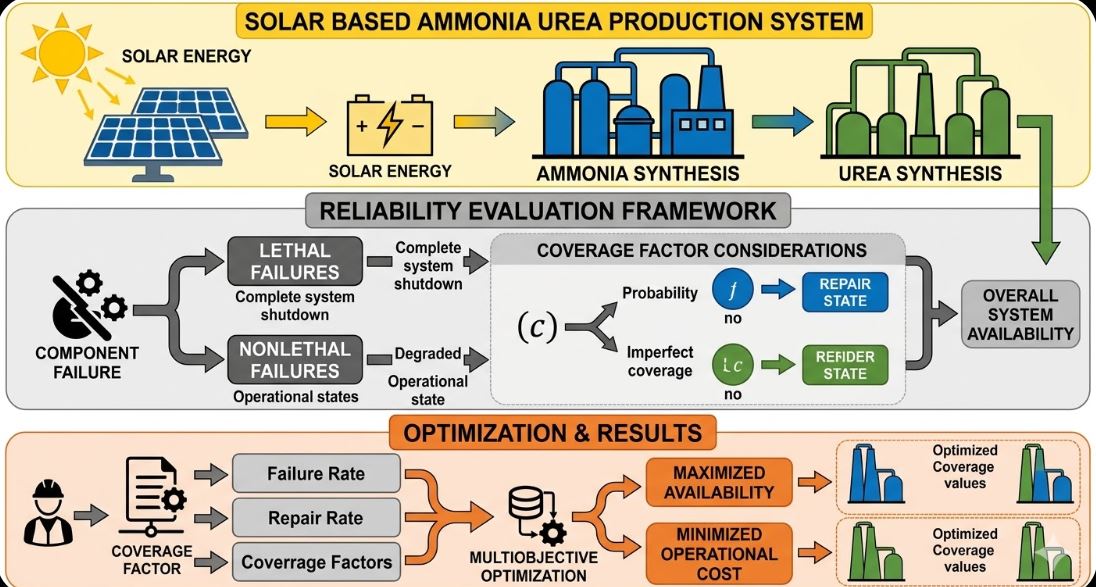
This study presents a comprehensive reliability evaluation and optimization framework for a solar-based ammonia-urea production system designed for Kano State, Nigeria, emphasizing the effects of lethal and nonlethal failures under varying coverage factor conditions. The proposed system integrates solar photovoltaic (PV) generation with electrolyzers, ammonia synthesis, and urea production units to promote sustainable fertilizer manufacturing suited to the climatic and energy conditions of Kano State. Reliability modeling was conducted using Reliability Block Diagrams (RBD) and Markov analysis to assess system performance under different failure and repair scenarios. Lethal failures, leading to total system shutdown, and nonlethal failures, causing partial performance loss, were analyzed to determine their impact on system availability, reliability, sensitivity and Cost (CARS). The coverage factor was incorporated to capture the influence of fault detection and recovery efficiency. Optimization studies focusing on redundancy allocation and improved fault coverage were performed to enhance system resilience. Results indicate that coverage factor placement significantly decrease system reliability, availability, or cost thereby making the solar-based ammonia-urea production system unviable and unsustainable solution for Kano State’s agricultural and energy needs.
Literaturhinweise