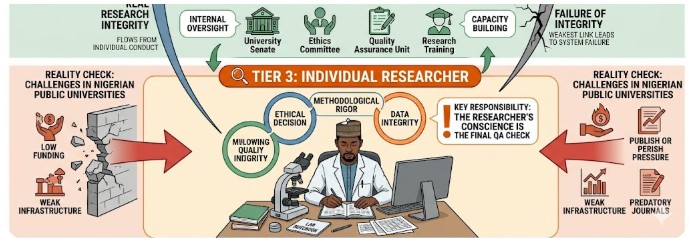
Quality Assurance as Individual Responsibility: The Three-Tier Reality of Research Integrity in Nigerian Public Universities
DOI:
https://doi.org/10.67868/erdfga45Schlagwörter:
research quality assurance; peer review; institutional review board; research integrity; Nigerian universities; predatory journals; Global South; academic integrity; under-resourced contexts; higher educationAbstract
When institutional infrastructure for research quality assurance fails, the consequences extend beyond individual careers to compromise an entire national knowledge system. This paper examines how quality assurance functions when formal mechanisms ethics review boards, plagiarism detection, peer review, and research integrity training are largely absent. Thematic analysis of 45 in-depth interviews at two Nigerian public universities reveals a three-tier quality assurance reality: formal mechanisms exist primarily on paper; informal peer networks serve as the primary operational quality control system for those with access; and individual moral commitment provides the last-resort foundation for those without, at the cost of significant psychological burden. The study documents pervasive policy-practice gaps, including non-functional IRBs (0–30% utilisation), cost-inaccessible plagiarism detection, and essentially absent research integrity training. It identifies a structural equity problem: quality assurance access is distributed along career advantage lines, with senior academics at federal institutions receiving genuine, if informal, quality review while junior academics at state institutions receive essentially none. This inequity is cumulative those with less quality feedback produce weaker research profiles, limiting their access to the very informal networks that provide quality support, and may ultimately exit the profession entirely. The study argues that predatory journal use, typically framed as individual ethical failure, is better understood as rational adaptation to structural conditions including absent quality infrastructure and perverse promotion incentives. Four priority interventions are indicated: IRB operationalisation beyond policy commitment; consortium-based plagiarism detection licensing led by the National Universities Commission; embedded research integrity training for early-career academics; and promotion criteria reform distinguishing publication quality from quantity.
Literaturhinweise