Markov Chain Analysis of Brand Switching Behavior among Instant Noodle Consumers in Nigeria
DOI:
https://doi.org/10.67868/nijor/0303.024Parole chiave:
Markov chain, Brand switching, Transition probability, Steady-state distribution, Instant noodles, FMCG, Nigeria.Abstract
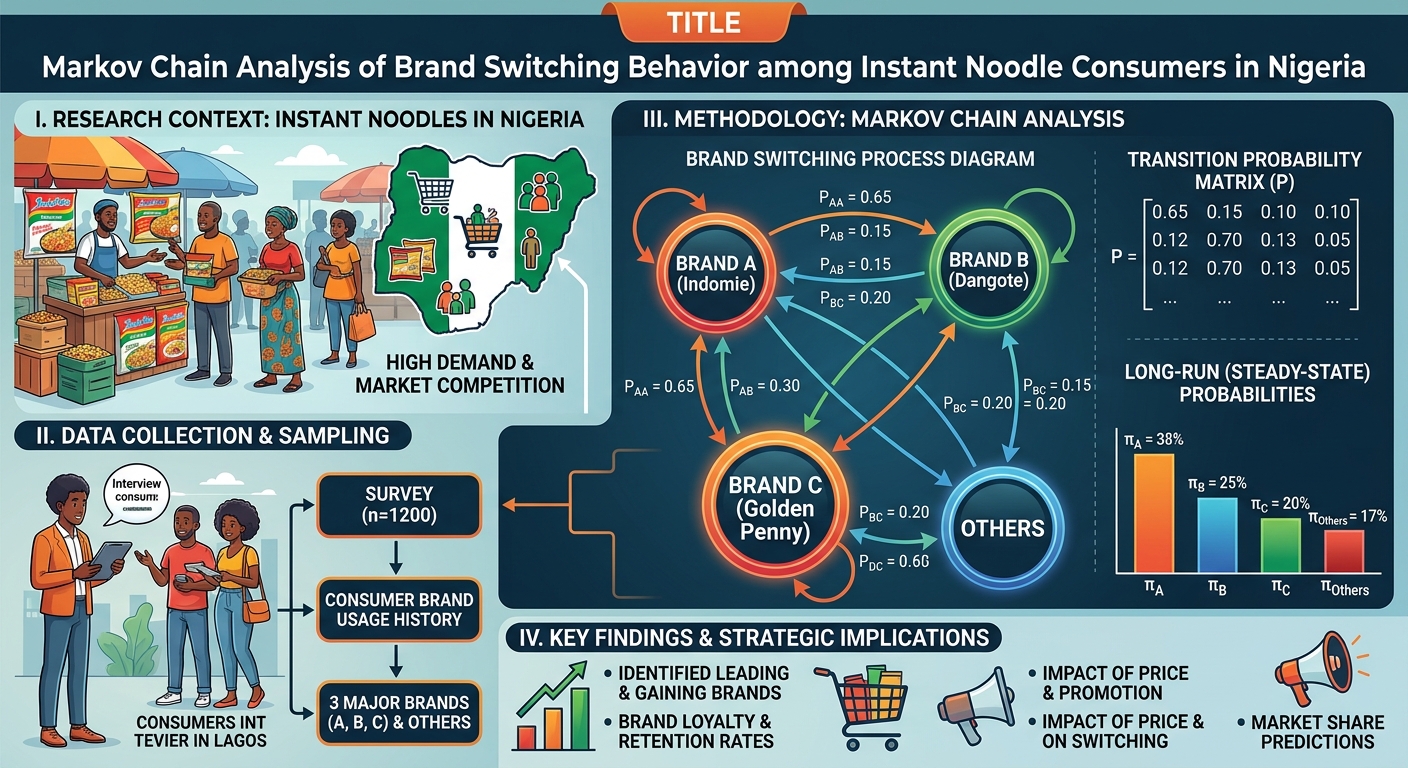
The study used a discrete-time Markov chain (DTMC) to examine brand switching among consumers of three instant noodle brands (Indomie, Supreme, and Minimie) at Girei Modern Market, Girei Local Government Area, Adamawa State, Nigeria. A structured questionnaire was administered to 100 respondents recruited by convenience sampling, and their previous and most recent purchases were used to estimate a 3 × 3 transition probability matrix. An Anderson–Goodman chi-square test rejected the hypothesis that current brand choice is independent of the previous choice (χ² (4) = 14.27, p = 0.006), supporting the Markov specification. Market shares were projected over three purchase periods, and the long-run (steady-state) distribution was derived. Supreme retained the largest proportion of its own buyers (62.9%) and attracted the largest proportions of buyers leaving Minimie (38.2%) and Indomie (32.3%). The model predicts that Supreme’s share rises from 35.0% to a steady-state value of 48.5%, while Indomie and Minimie settle at 27.5% and 24.0%, respectively. Bootstrap confidence intervals and a sensitivity analysis of the retention probabilities show that the exact equilibrium shares are imprecise at n = 100, but Supreme’s leading position is robust. Product availability and price were the most frequently cited reasons for switching, and the pattern of reasons differed significantly across brands (χ² (10) = 44.97, p < 0.001). Because the data come from a single-market convenience sample, the results are an exploratory baseline for Girei rather than estimates for Adamawa State as a whole. The study shows that a Markov chain fitted to simple survey data gives fast-moving consumer goods (FMCG) firms in data-scarce markets a low-cost way to monitor and anticipate brand switching.
Riferimenti bibliografici