Optimal Control of Typhoid Fever Transmission With Imperfect Diagnosis and Multiple Interventions
DOI :
https://doi.org/10.67868/gfg28r12Mots-clés :
Typhoid Fever, Optimal Control, Imperfect Diagnosis, Mathematical Modeling, Cost Effectiveness, Sensitivity Analysis, Pontryagin’s Maximum PrincipleRésumé
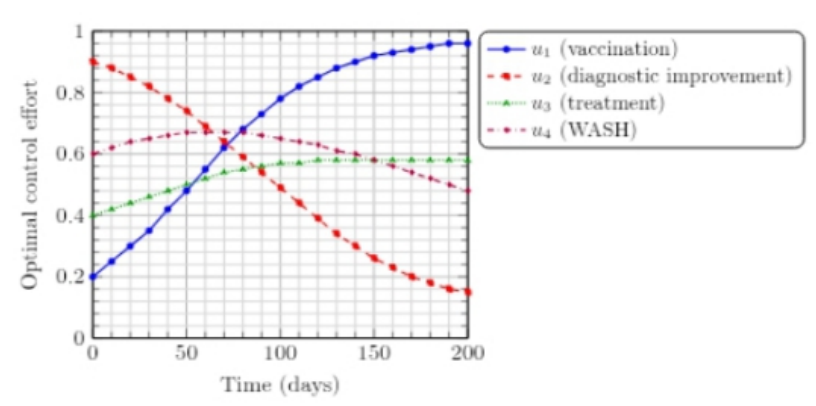
Typhoid fever persists in regions with poor sanitation and weak healthcare infrastructure, exacerbated by diagnostic inaccuracies—specifically false-negative test results—that leave infectious individuals untreated and sustain transmission. This study extends a deterministic compartmental model (PSIDT) to incorporate the epidemiological impact of imperfect diagnosis. Applying Pontryagin’s maximum principle, optimal control schedules are derived for four interventions: vaccination, diagnostic improvement, enhanced treatment, and water, sanitation, and hygiene (WASH) programs. Numerical simulations demonstrate that integrating these interventions reduces both infectious and misdiagnosed cases by more than 95% within 50 days. Incremental cost-effectiveness ratio (ICER) analysis reveals that improving diagnostic accuracy alone is the most cost-effective single strategy, costing 4.35 thousand Naira per averted infection, while the combined strategy averts the highest number of infections (950 per 1,000 cases) while maintaining a favorable ICER. Consequently, enhancing diagnostic accuracy should be prioritized alongside comprehensive public health measures in typhoid-endemic regions, as this optimal control framework offers practical, data-driven guidance for resource allocation.
Références