Adaptation of Artificial Bee Colony Algorithm for Solving Inventory Routing Problem
DOI:
https://doi.org/10.67868/30k3je50Parole chiave:
Artificial Bee Colony, Inventory Routing Problem, Modified Artificial Bee Colony, RAODEF-EURO Challenge 2016, Optimization ModelAbstract
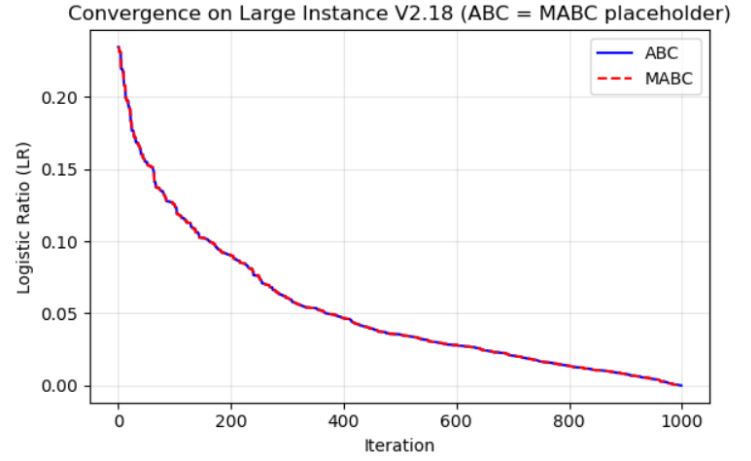
This study applies the Artificial Bee Colony (ABC) algorithm to the Inventory Routing Problem (IRP), using real-world data from the RAODEF-EURO Challenge 2016 on liquid-gas distribution. The research develops a feasible optimization model for IRP scenarios involving 1–13 drivers and 1–15 trailers delivering products from a central depot to 200–324 customers over planning horizons ranging from one week to one month. The model incorporates standard IRP constraints and aims to minimize the logistic ratio, defined as delivery cost relative to transported volume over time. Addressing IRP is essential in operations research, as it requires balancing varying customer demands with long-term distribution efficiency. Although previous heuristic and hyper-heuristic approaches achieved partial success, many struggled with scalability in large, constraint-intensive instances. To overcome these limitations, this study evaluates both the standard Artificial Bee Colony algorithm and a Modified Artificial Bee Colony (MABC) variant. Their performances are assessed using fifteen benchmark instances (Instance B). Results show that both algorithms generated feasible solutions across all datasets. However, the MABC consistently achieved lower logistic ratios and improved cost efficiency in most instances, outperforming the standard ABC in solution quality. The overall findings demonstrate that the MABC offers a more robust and scalable approach for solving complex IRP scenarios, making it a promising tool for practical logistics planning and decision-making.
Riferimenti bibliografici