Development and Evaluation of an Annotated Nya-Həba Corpus for Named Entity Recognition
DOI :
https://doi.org/10.67868/nijor/0304.032Mots-clés :
Nya-Həba, Kilba, named entity recognition, corpus annotation, inter-annotator agreement, CRF, BiLSTM-CRFRésumé
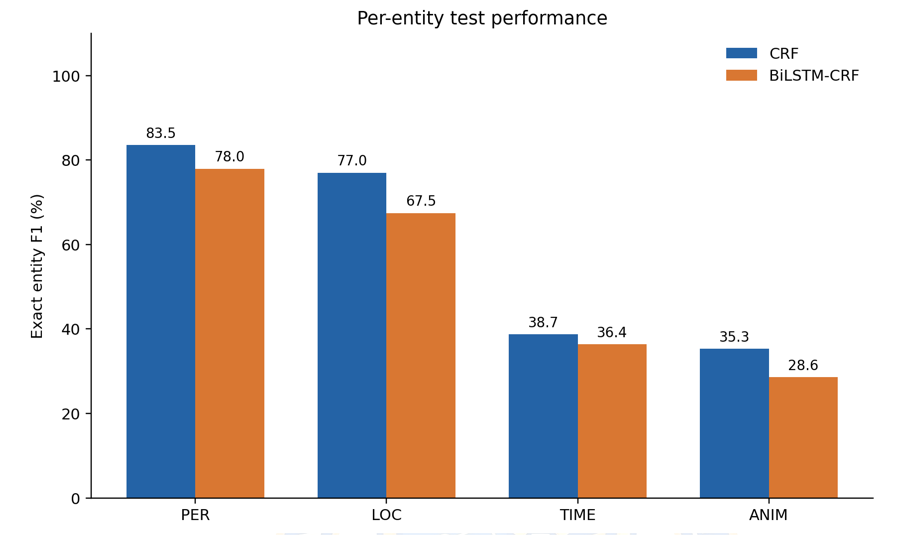
corpus for named entity recognition (NER). Nya-Həba, also known as Huba or Kilba, is spoken by the Həba community in Hong Local Government Area, Adamawa State, north-eastern Nigeria. Texts from documentary and community sources were prepared, segmented and labelled in Label Studio. The resulting resource contains 2,038 annotation units, 27,123 tokens and 1,928 adjudicated entity mentions. The annotation covers people, places, temporal expressions and indigenous animal terms. Two fluent speakers labelled the same material independently using contextual beginning–inside–outside (BIO) rules; a third fluent speaker reviewed and resolved disagreements. Before adjudication, token agreement stood at 98.03%, with Cohen’s κ = 0.8631 and exact entity-span/type F1 of 86.17%. The review identified 535 disputed tokens across 304 units. Three further personal-name labels on which the annotators had agreed were subsequently changed to O, and these corrections are recorded separately. Both original annotation files and the correction audit have been retained. Using a common split of approximately 70% training, 15% validation and 15% test data, the feature-based conditional random field (CRF) achieved 75.35% entity F1, compared with 68.19% for a bidirectional long short-term memory–conditional random field (BiLSTM-CRF) using randomly initialized embedding. The study’s contribution is the documented corpus-building process, including source preparation, independent annotation, agreement analysis, adjudication and reproducible baseline experiments. Most of the material comes from biblical narrative because substantial, consistently written Nya-Həba materials are scarce, and these narrative books offer continuous contextual examples of persons, places and temporally situated events, while temporal and animal examples are relatively few. Written authorization was obtained from the relevant language development and Bible translation organizations. The corpus and reproducibility materials are available through Zenodo subject to the applicable source-use conditions.
Références
Adelani, D. I., Abbott, J., Neubig, G., D’souza, D., Kreutzer, J., Lignos, C., Palen-Michel, C., Buzaaba, H., Rijhwani, S., Ruder, S., Mayhew, S., Azime, I. A., Muhammad, S. H., Emezue, C. C., Nakatumba-Nabende, J., Ogayo, P., Anuoluwapo, A., Gitau, C., Mbaye, D., Alabi, J., Yimam, S. M., Gwadabe, T. R., Ezeani, I., Niyongabo, R. A., Mukiibi, J., Otiende, V., Orife, I., David, D., Ngom, S., Adewumi, T., Rayson, P., Adeyemi, M., Muriuki, G., Anebi, E., Chukwuneke, C., Odu, N., Wairagala, E. P., Oyerinde, S., Siro, C., Bateesa, T. S., Oloyede, T., Wambui, Y., Akinode, V., Nabagereka, D., Katusiime, M., Awokoya, A., Mboup, M., Gebreyohannes, D., Tilaye, H., Nwaike, K., Wolde, D., Faye, A., Sibanda, B., Ahia, O., Dossou, B. F. P., Ogueji, K., Diop, T. I., Diallo, A., Akinfaderin, A., Marengereke, T., & Osei, S. (2021). MasakhaNER: Named entity recognition for African languages. Transactions of the Association for Computational Linguistics, 9, 1116–1131. https://aclanthology.org/2021.tacl-1.66/ DOI: https://doi.org/10.1162/tacl_a_00416
Adelani, D. I., Neubig, G., Ruder, S., Rijhwani, S., Beukman, M., Palen-Michel, C., Lignos, C., Alabi, J. O., Muhammad, S. H., Nabende, P., Dione, C. M. B., Bukula, A., Mabuya, R., Dossou, B. F. P., Sibanda, B., Buzaaba, H., Mukiibi, J., Kalipe, G., Mbaye, D., Taylor, A., Kabore, F., Emezue, C. C., Aremu, A., Ogayo, P., Gitau, C., Munkoh-Buabeng, E., Memdjokam Koagne, V., Tapo, A. A., Macucwa, T., Marivate, V., Mboning, E., Gwadabe, T., Adewumi, T., Ahia, O., Nakatumba-Nabende, J., Mokono, N. L., Ezeani, I., Chukwuneke, C., Adeyemi, M., Hacheme, G. Q., Abdulmumin, I., Ogundepo, O., Yousuf, O., Moteu Ngoli, T., & Klakow, D. (2022). MasakhaNER 2.0: Africa-centric transfer learning for named entity recognition. In Proceedings of the 2022 Conference on Empirical Methods in Natural Language Processing (pp. 4488–4508). Association for Computational Linguistics. https://doi.org/10.18653/v1/2022.emnlp-main.298 DOI: https://doi.org/10.18653/v1/2022.emnlp-main.298
Agić, Ž., Hovy, D., & Søgaard, A. (2015). If all you have is a bit of the Bible: Learning POS taggers for truly low-resource languages. In Proceedings of the 53rd Annual Meeting of the Association for Computational Linguistics and the 7th International Joint Conference on Natural Language Processing (Volume 2: Short Papers) (pp. 268–272). Association for Computational Linguistics. https://doi.org/10.3115/v1/P15-2044 DOI: https://doi.org/10.3115/v1/P15-2044
Alabi, J. O., Adelani, D. I., Mosbach, M., & Klakow, D. (2022). Adapting pre-trained language models to African languages via multilingual adaptive fine-tuning. In Proceedings of the 29th International Conference on Computational Linguistics (pp. 4336–4349). International Committee on Computational Linguistics. https://aclanthology.org/2022.coling-1.382/
Alabi, J. O., Amponsah-Kaakyire, K., Adelani, D. I., & España-Bonet, C. (2020). Massive vs. curated embeddings for low-resourced languages: The case of Yorùbá and Twi. In Proceedings of the Twelfth Language Resources and Evaluation Conference (pp. 2754–2762). European Language Resources Association. https://aclanthology.org/2020.lrec-1.335/
Artstein, R., & Poesio, M. (2008). Inter-coder agreement for computational linguistics. Computational Linguistics, 34(4), 555–596. https://doi.org/10.1162/coli.07-034-R2 DOI: https://doi.org/10.1162/coli.07-034-R2
Asiimwe, P. A., Meyer, F., & Buys, J. (2026). RunyaNER: Auxiliary language selection for Runyankore NER. In Proceedings of the 6th Workshop on Multilingual Representation Learning (MRL 2026) (pp. 480–491). Association for Computational Linguistics. https://aclanthology.org/2026.mrl-1.38/ DOI: https://doi.org/10.18653/2026.mrl-1.38
Balama, K. H. (2024, October 8). Milestone in promotion of Həba language and culture. News Hunter. https://thenewshunterblog.wordpress.com/2024/10/08/milestone-in-promotion-of-heba-language-and-culture/
Christodoulopoulos, C., & Steedman, M. (2015). A massively parallel corpus: The Bible in 100 languages. Language Resources and Evaluation, 49, 375–395. https://doi.org/10.1007/s10579-014-9287-y DOI: https://doi.org/10.1007/s10579-014-9287-y
Cohen, J. (1960). A coefficient of agreement for nominal scales. Educational and Psychological Measurement, 20(1), 37–46. https://doi.org/10.1177/001316446002000104 DOI: https://doi.org/10.1177/001316446002000104
Falola, P. B., Alabi, J. O., Akinola, S. O., Ogunajo, F. T., Alabi, E. O., & Adelani, D. I. (2026). YoNER: A new Yorùbá multi-domain named entity recognition dataset. In Proceedings of the Fifteenth Language Resources and Evaluation Conference (pp. 7137–7148). https://doi.org/10.63317/4o6m2hzpy7gs DOI: https://doi.org/10.63317/4o6m2hzpy7gs
Glottolog. (n.d.). Huba [Language catalogue entry; ISO 639-3: hbb; Glottocode: huba1236]. Retrieved November 23, 2026, from https://glottolog.org/resource/languoid/id/huba1236
Hedderich, M. A., Adelani, D. I., Zhu, D., Alabi, J., Markus, U., & Klakow, D. (2020). Transfer learning and distant supervision for multilingual transformer models: A study on African languages. In Proceedings of the 2020 Conference on Empirical Methods in Natural Language Processing (EMNLP) (pp. 2580–2591). Association for Computational Linguistics. https://aclanthology.org/2020.emnlp-main.204/ DOI: https://doi.org/10.18653/v1/2020.emnlp-main.204
Huang, Z., Xu, W., & Yu, K. (2015). Bidirectional LSTM-CRF models for sequence tagging [Preprint]. arXiv. https://doi.org/10.48550/arXiv.1508.01991
Lafferty, J., McCallum, A., & Pereira, F. (2001). Conditional random fields: Probabilistic models for segmenting and labeling sequence data. In Proceedings of the Eighteenth International Conference on Machine Learning (pp. 282–289). Morgan Kaufmann.
Muazu, M. A. (2009). The Hong and Gaya dialects of Kilba. California Linguistic Notes, 34(2), 1–7.
Ogueji, K., Zhu, Y., & Lin, J. (2021). Small data? No problem! Exploring the viability of pretrained multilingual language models for low-resourced languages. In Proceedings of the 1st Workshop on Multilingual Representation Learning (pp. 116–126). Association for Computational Linguistics. https://doi.org/10.18653/v1/2021.mrl-1.11 DOI: https://doi.org/10.18653/v1/2021.mrl-1.11
Pan, X., Zhang, B., May, J., Nothman, J., Knight, K., & Ji, H. (2017). Cross-lingual name tagging and linking for 282 languages. In Proceedings of the 55th Annual Meeting of the Association for Computational Linguistics (Volume 1: Long Papers) (pp. 1946–1958). Association for Computational Linguistics. https://doi.org/10.18653/v1/P17-1178 DOI: https://doi.org/10.18653/v1/P17-1178
Pustejovsky, J., & Stubbs, A. (2012). Natural language annotation for machine learning: A guide to corpus-building for applications. O’Reilly Media.
Tjong Kim Sang, E. F., & De Meulder, F. (2003). Introduction to the CoNLL-2003 shared task: Language-independent named entity recognition. In Proceedings of the Seventh Conference on Natural Language Learning at HLT-NAACL 2003 (pp. 142–147). Association for Computational Linguistics. https://aclanthology.org/W03-0419/ DOI: https://doi.org/10.3115/1119176.1119195
Wycliffe Bible Translators, Inc., & Nigeria Bible Translation Trust. (2018). Taɗər Alkawal Aku Nya Həba [Nya-Həba New Testament]. Nigeria Bible Translation Trust. https://www.bible.com/versions/2723-hbbnt-taɗər-alkawal-aku-nya-həba
Zenodo. (2026). Zenodo Open Research Repository. https://doi.org/10.5281/zenodo.23328858
Fichiers supplémentaires
Publié
Numéro
Rubrique
Licence
© Nigerian Journal of Operations Research 2026

Cette œuvre est sous licence Creative Commons Attribution - Pas d'Utilisation Commerciale - Pas de Modification 4.0 International.