
A Comprehensive Review of Machine Learning Techniques for Facies Classification in Oil and Gas Exploration: Methods, Challenges, and Future Directions
DOI:
https://doi.org/10.67868/cq8pt142Keywords:
Well logs, Machine Learning, Facies Classifications, Lithofacies, Siesmic interpretation, Reservior characterizationAbstract
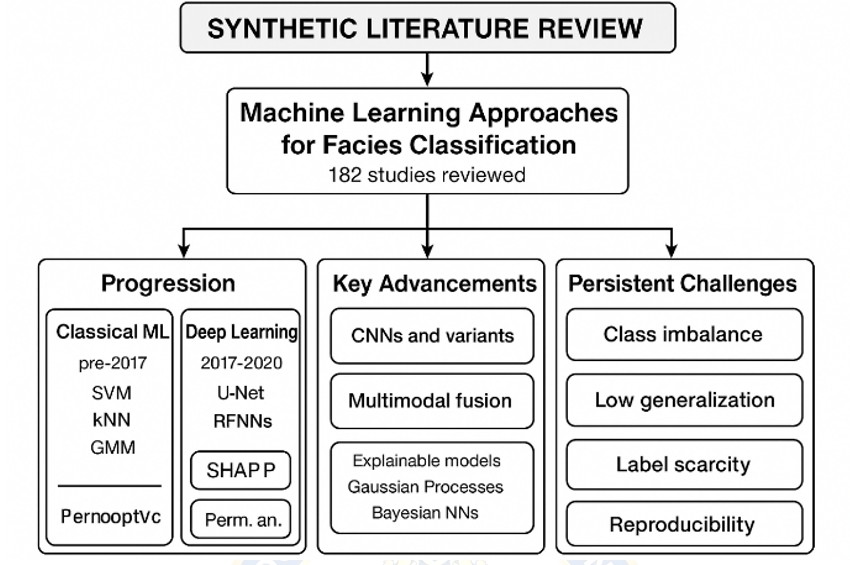
Facies classification is an important part of reservoir characterization and hydrocarbon exploration, in order to provide an accurate understanding of the reservoir and provide development planning for the field. Traditional approaches relied on manual interpretation of well logs, seismic data, and core samples. This method was time-intensive and introduced interpreter bias in the data, leading to inconsistent results. Machine learning has emerged as a transformative tool in geoscience, making it possible to classify facies automatically and accurately. This review looks at how machine learning is used for facies classification. We group the methods into algorithms, ensemble models, and deep learning architectures. Researchers emphasize the critical importance of data preparation, feature engineering, and multi-modal data integration. We look at what other people have discovered to see how well the models work, what data they need, and if they make sense from a geological point of view. Facies classification and machine learning are closely related. We discuss the challenges we are facing now, what is new and trending, and what we still need to work on. This synthesis provides a roadmap for advancing ML-based facies classification and identifies priorities for future research.References
Downloads
Published
21-05-2026
Issue
Section
Articles
How to Cite
A Comprehensive Review of Machine Learning Techniques for Facies Classification in Oil and Gas Exploration: Methods, Challenges, and Future Directions. (2026). Nigerian Journal of Operations Research, 3(2), 145-160. https://doi.org/10.67868/cq8pt142